
EBC-46 Human Trials Update 2026: What the Latest Clinical Research Shows

If you've been following the science behind Blushwood Berry extract, 2026 is shaping up to be one of the most significant years yet for EBC-46 research. The compound — formally known as tigilanol tiglate — has moved well beyond early-stage laboratory work and into multi-centre human clinical trials that are producing encouraging data. Here's what the latest published research tells us, and what it means for anyone interested in the science of this remarkable Australian botanical.
Phase IIa Soft Tissue Sarcoma Trial: 80% Response Rate
The headline development in EBC-46 clinical research is the Phase IIa trial (QB46C-H07) for soft tissue sarcoma (STS), conducted at Memorial Sloan Kettering Cancer Center in New York under principal investigator Dr Edmund Bartlett. In Stage 1 of this open-label study, 11 patients with advanced or metastatic soft tissue sarcoma received intratumoral injections of tigilanol tiglate at a dose of 0.5 mg per cubic centimetre of tumour volume.[1]
The results were striking. Among 10 evaluable patients, eight achieved either complete or partial ablation of their treated tumours — an objective response rate of 80%. At the individual tumour level, 22 of 27 injected tumours (81%) responded, with 14 achieving complete ablation and eight showing partial ablation. Perhaps most encouraging, none of the 14 completely ablated tumours had recurred at the six-month follow-up mark.[1]
The treatment was well tolerated. Most adverse events were localised and expected — pain, swelling, and necrosis at the injection site — consistent with the drug's mechanism of targeted tumour destruction. Stage 2 of this trial is now enrolling up to 40 additional patients with angiosarcoma, leiomyosarcoma, myxofibrosarcoma, and other mixed-origin sarcomas.[1]
Head and Neck Cancer: Safety Confirmed, Phase II Underway
EBC-46 has also completed a Phase I/IIa dose-escalation trial (QB46C-H03) in 19 patients with head and neck squamous cell carcinoma, conducted across sites in Australia and India. The study met its primary endpoint of safety and tolerability, with doses escalated to 2.4 mg/m² without reaching a maximum tolerated dose.[2]
Rapid, drug-induced haemorrhagic necrosis was observed in all injected tumours at every dose level — and importantly, no necrosis of surrounding healthy tissue was reported for any patient. Translational research from this trial also revealed markers of immunogenic cell death and increased immune cell infiltration in tumour samples, suggesting EBC-46 may help stimulate the body's own immune response against cancer cells.[2]
Building on these findings, a multi-centre Phase II efficacy trial (QB46C-H08) is now active at sites in Australia and the United Kingdom, evaluating tigilanol tiglate in up to 37 patients with a broad range of solid head and neck tumours.[2]
How EBC-46 Works: PKC Activation and Beyond
Understanding why EBC-46 produces these clinical effects requires looking at its molecular mechanism. Research published in Scientific Reports has established that tigilanol tiglate activates classical protein kinase C (PKC) isoforms, a family of enzymes involved in cellular signalling, wound healing, and immune response.[3]
More recent work published in 2024 in the Journal for ImmunoTherapy of Cancer has revealed that tigilanol tiglate also induces immunogenic cell death through PKC-independent pathways, including endoplasmic reticulum stress and gasdermin E-dependent pyroptosis. This dual mechanism — direct tumour ablation plus immune system activation — may help explain the durable responses observed in clinical trials and the absence of recurrence in completely ablated tumours.[4]
For those taking EBC-46 as a dietary supplement derived from Fontainea picrosperma seeds, this PKC-activating property is also linked to the compound's ability to support cellular signalling, skin renewal, and immune function at the everyday wellness level.
Emerging Research: EBC-46 Analogs and HIV
In a fascinating expansion of EBC-46 science, Stanford University researchers published a January 2025 study in Science Advances demonstrating that tigilanol tiglate analogs show remarkable potential as HIV latency-reversing agents. Some analogs reversed latency in 90% of treated cells — a fourfold improvement over bryostatin, the previous benchmark compound.[5]
While this research is still preclinical, it highlights the broader biological significance of the PKC-activating compounds found in Blushwood Berry and underscores why Fontainea picrosperma continues to attract serious scientific attention well beyond its original cancer research applications.
What This Means for Blushwood Berry Supplement Users
It's important to distinguish between intratumoral injection of pharmaceutical-grade tigilanol tiglate in clinical trials and oral supplementation with whole-seed Blushwood Berry extract. The clinical trials use a purified, injectable form at specific doses under medical supervision. Dietary supplements like those offered by Blushwood Health contain the full spectrum of bioactive compounds from Fontainea picrosperma seeds in a 10:1 concentrated extract, taken orally to support general wellness.
That said, the growing body of peer-reviewed research validates the biological activity of the compounds in Blushwood Berry and provides a scientific foundation for understanding why so many customers report benefits across the areas of immune function, skin health, energy, and inflammation response. Every batch of Blushwood Health's extract is independently tested by Eurofins laboratories to confirm identity, purity, and potency — because when the science is this promising, quality and transparency matter more than ever.
Häufig gestellte Fragen
What is the current status of EBC-46 human clinical trials?
As of 2026, EBC-46 (tigilanol tiglate) has active Phase II clinical trials for soft tissue sarcoma (at Memorial Sloan Kettering Cancer Center) and head and neck cancer (in Australia and the UK). The soft tissue sarcoma trial reported an 80% objective response rate in Stage 1, and Stage 2 expansion is now enrolling additional patients.
Has EBC-46 received any regulatory approvals?
Tigilanol tiglate received FDA and EMA approval in 2020 as Stelfonta® for veterinary use in canine mast cell tumours. It also received FDA orphan drug designation for soft tissue sarcoma in February 2024. Human clinical trials are ongoing but the compound has not yet received approval for human therapeutic use.
Is taking an EBC-46 supplement the same as the clinical trial treatment?
No. Clinical trials use purified, injectable tigilanol tiglate administered directly into tumours under medical supervision. EBC-46 dietary supplements contain whole-seed Blushwood Berry (Fontainea picrosperma) extract taken orally as part of a wellness routine. The two forms differ in concentration, delivery method, and intended use.
What makes Fontainea picrosperma different from other Blushwood Berry species?
Fontainea picrosperma is the species used in all published EBC-46 research and clinical trials. Some supplement brands use Hylandia dockrillii, a different tree sometimes called “blushwood,” which has not been the subject of the same peer-reviewed research. Always verify the species when choosing a Blushwood Berry supplement.
Explore Blushwood Berry Extract
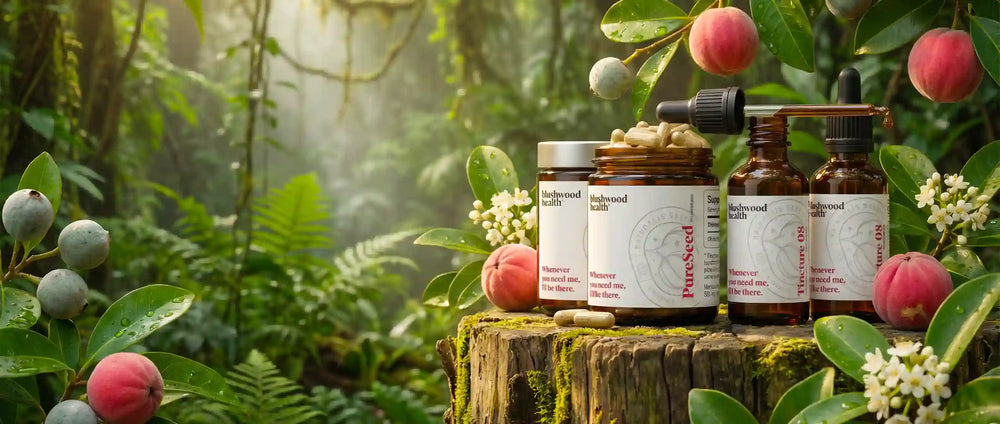
Ready to experience the benefits of genuine Fontainea picrosperma extract? Blushwood Health offers two convenient formats: Tincture 08, a liquid extract that can be used both orally (sublingually, under the tongue) and topically on the skin, made with just three ingredients (Blushwood Berry extract, vegetable glycerin, and purified water), and PureSeed Capsules, a 90-count bottle of concentrated whole-seed extract. Both are Eurofins lab-tested and made exclusively from Fontainea picrosperma. Browse the full collection here.
Referenzen
- QBiotics Group Limited. “QBiotics reports 80% objective response rate in injected tumours in Stage 1 of Phase IIa clinical trial of tigilanol tiglate for Soft Tissue Sarcoma.” Press release, 2025. ClinicalTrials.gov: NCT05755113.
- QBiotics Group Limited. “QBiotics’ tigilanol tiglate meets Primary Endpoints in its Phase I/IIa head and neck cancer dose escalation trial.” Press release, 2024. Trial: QB46C-H03.
- Boyle GM, et al. “Activation of PKC supports the anticancer activity of tigilanol tiglate and related epoxytiglianes.” Scientific Reports. 2021;11(1):1774. PMID: 33420238.
- Cullen JK, et al. “Tigilanol tiglate is an oncolytic small molecule that induces immunogenic cell death and enhances the response of both target and non-injected tumors to immune checkpoint blockade.” Journal for ImmunoTherapy of Cancer. 2024;12(4):e008385. PMID: 38658031.
- Tran BN, et al. “Synthesis and preclinical evaluation of tigilanol tiglate analogs as latency-reversing agents for the eradication of HIV.” Science Advances. 2025;11(4):eads1911. PMID: 39854456.
- Panizza BJ, et al. “Phase I dose-escalation study to determine the safety, tolerability, preliminary efficacy and pharmacokinetics of an intratumoral injection of tigilanol tiglate (EBC-46).” EBioMedicine. 2019;50:433-441. PMID: 31810818.
*These statements have not been evaluated by the Food and Drug Administration. This product is not intended to diagnose, treat, cure, or prevent any disease. The clinical trial information presented in this article describes pharmaceutical research on tigilanol tiglate and should not be interpreted as evidence that dietary supplements can produce the same effects.