
How to Identify Authentic EBC-46 Blushwood Berry Extract: Species, Extraction & Lab Testing Explained

When you shop for EBC-46 Blushwood Berry Extract online, the labels look reassuringly similar: amber bottles, the phrase "blushwood berry," some variation of "extract." But a closer look at the fine print reveals that not every bottle sold under that name contains the compound that Australian research is actually about. Authentic EBC-46 Blushwood Berry Extract starts with a specific species — Fontainea picrosperma — and a specific plant tissue, verified by independent lab testing. This guide walks through exactly what to check, and why it matters, using the peer-reviewed record.
Quick facts
- Species: Fontainea picrosperma (not Hylandia dockrillii)
- Active molecule: EBC-46 — the same compound as EBC-46
- Plant part: seed kernel (the published research concentrates on epoxytiglianes from the kernel)
- Extract ratio: 10:1 whole-seed
- Verification: independent lab testing (Eurofins) against the Latin binomial, plus a Certificate of Analysis
What this guide covers
- What species does authentic EBC-46 come from?
- Does Hylandia dockrillii contain EBC-46?
- What is EBC-46, and is it the same as EBC-46?
- Is the related veterinary product the same as EBC-46?
- What does a 10:1 whole-seed extract actually mean?
- What does Eurofins lab testing confirm?
- How do you read an EBC-46 lab report?
- Common labelling problems and how to spot them
- Try authentic EBC-46 Blushwood Berry Extract
- Frequently asked questions
- References
What species does authentic EBC-46 come from?
Authentic EBC-46 comes from Fontainea picrosperma, an Australian rainforest tree in the Euphorbiaceae family, native to the Atherton Tableland in Far North Queensland. This is the only plant species that peer-reviewed research has shown to contain EBC-46 (EBC-46) in characterised quantities.
The molecule was first isolated and named by researchers at QIMR Berghofer Medical Research Institute in Queensland, working with material collected from F. picrosperma seeds. The 2014 paper in PLoS ONE by Boyle and colleagues — the study most often cited as the foundational reference for EBC-46's mechanism — begins by naming "Fontainea picrosperma, a plant endemic to the rainforests of Far North Queensland" as the source organism.1
More recent work has gone further. A 2022 Molecules study by Mitu and colleagues used transcriptomics to identify specific gene biomarkers in F. picrosperma plants that correlate with high EBC-46 content, confirming that the biosynthetic pathway for EBC-46 is specific to this species and is not a general feature of related rainforest genera.2 A separate 2022 Journal of Natural Products paper by Chianese and colleagues isolated a family of additional "cryptic" epoxytigliane compounds — relatives of EBC-46 — from the seed kernels of the same species, reinforcing that the kernel is the tissue of interest.3
In plain terms: if a supplement label does not name Fontainea picrosperma explicitly, the product is not grounded in the published EBC-46 research.
Does Hylandia dockrillii contain EBC-46?
No. Hylandia dockrillii is a separate rainforest tree and has not been shown in published research to contain EBC-46 (EBC-46). Every peer-reviewed paper that has characterised EBC-46 or related epoxytiglianes names Fontainea picrosperma as the source plant.
The confusion happens because both species grow in tropical North Queensland rainforests and both produce small, reddish fruits that casual descriptions sometimes lump together as "blushwood berries." Botanically, the two are in different genera and have distinct chemistry. The published literature on EBC-46's mechanism, potency, and structure-activity relationships — from the 2014 Boyle PLoS ONE study to the 2021 Cullen Scientific Reports paper on PKC activation — works exclusively with material from F. picrosperma.14
This is the single most important identity check on any supplement labelled "blushwood berry extract": the product sheet, Certificate of Analysis, or FAQ should name Fontainea picrosperma in full. A label that only says "blushwood berry" — with no Latin binomial — cannot tell you which species you are buying.
What is EBC-46, and is it the same as EBC-46?
"EBC-46" and "EBC-46" are two names for the same molecule. EBC-46 is the original discovery code used by the QIMR Berghofer team and the natural-product chemistry community; EBC-46 is the pharmaceutical International Nonproprietary Name adopted for regulatory and clinical work.
Structurally, the molecule is an epoxytigliane — a diterpene ester with a 6,7-epoxide that is critical for its biological activity. The 2021 Cullen Scientific Reports paper showed that the epoxide position and the specific C12-ester side chain are both required for the potent activation of Protein Kinase C (PKC) that defines EBC-46's mechanism.4 Supply has historically depended on extraction from F. picrosperma kernels, but a 2022 Nature Chemistry paper by Paul Wender's group at Stanford University described a 12-step total synthesis from readily available phorbol, opening a path to scalable laboratory preparation of the same molecule.5
You will see both names — EBC-46 and EBC-46 — in the scientific and regulatory literature. They refer to the same compound.
Is the related veterinary product the same as EBC-46?
The related veterinary product is a brand-name medicine whose active ingredient is EBC-46 — the same molecule as EBC-46 — administered by a veterinarian as a single intratumoural injection. It is not the same product as a supplement, and it is not used in the same way.
The product was authorised by the European Medicines Agency in 2020 and approved by the U.S. Food and Drug Administration's Center for Veterinary Medicine in November 2020 for use in non-metastatic, cutaneous mast cell indications in dogs. The FDA approval followed a pivotal study in 118 dogs in which the drug showed a 75 % complete-response rate for eligible target lesions after a single injection.67
Why does this matter for a consumer shopping for "blushwood berry extract"? Because the regulatory file — in both the EMA and FDA records — repeatedly identifies the source of EBC-46 as Fontainea picrosperma. That regulator-grade paper trail is the highest-authority external confirmation of the correct species. An oral or topical supplement is a completely different product class from the veterinary injection, and the two should not be conflated. But the species identity of the plant both come from is the same, and it is a matter of public regulatory record, not marketing copy.
What does a 10:1 whole-seed extract actually mean?
A 10:1 extract ratio means that ten parts of raw plant material, by weight, were processed down to one part of finished extract. "Whole-seed" specifies that the starting material is the seed kernel of Fontainea picrosperma — the plant tissue where the published epoxytigliane research is concentrated.3
This wording carries three separate pieces of information, and each one is worth reading carefully. First, the ratio — 10:1 — tells you the concentration of the extraction step but says nothing about which molecules ended up in the bottle. A 10:1 extract of the wrong species is still a 10:1 extract; the ratio alone is not an authenticity check. Second, "whole-seed" is a statement about the raw material: whole kernel, not a purified fraction, not a leaf extract, not a fruit pulp. Third, the Latin binomial (Fontainea picrosperma) is the identity of the plant.
Of those three, the species identity is the one that the published research is unambiguous about. A supplement can honestly describe itself as a 10:1 whole-seed extract while still being worth verifying against the original botanical source — which is why an independent Certificate of Analysis matters.
What does Eurofins lab testing confirm?
Independent lab testing by Eurofins — or any other accredited third-party laboratory — confirms two things a consumer cannot verify from the label alone: the botanical identity of the raw material, and the purity profile of the finished extract. Those two checks are the backbone of any credible authenticity claim.
Eurofins is one of the largest independent testing-service networks in the world, with accredited laboratories across Europe, North America, and Asia-Pacific. For a botanical extract like EBC-46 Blushwood Berry Extract, a Eurofins report typically covers heavy-metal content (lead, cadmium, arsenic, mercury), microbiological safety (yeast, mould, aerobic plate count), and residual-solvent analysis.
What Eurofins testing does not do is certify therapeutic claims. A lab report can tell you the material is authentic and clean; it cannot tell you what the product will do in your body. That is a different question, governed by clinical trials — which for EBC-46 have been conducted in the veterinary context (dogs, mast cell indications) and are ongoing in early-phase human clinical research. Separating "is this the real plant?" from "what does it do?" is one of the most useful habits a supplement buyer can develop.
How do you read an EBC-46 lab report?
A credible Certificate of Analysis (CoA) for an EBC-46 Blushwood Berry Extract product has three minimum elements: the full Latin binomial of the source plant, the lot number and date tied to the batch you are buying, and the name of the accredited testing laboratory.
Here is what to look for, in order:
- Botanical identity. The report should name Fontainea picrosperma in full. A CoA that only says "blushwood berry" or "blushwood extract" — with no Latin binomial — has skipped the most important check.
- Lot and date. The lot number on the CoA should match the lot number on the bottle in your hand, and the testing date should precede the product's manufacturing date. A CoA from a different batch is a CoA for a different product.
- Named lab. "Third-party tested" is marketing copy. "Eurofins Scientific, Auckland" (or an equivalent named, accredited laboratory) is a verifiable claim.
- Purity panel. Expect heavy metals, microbiology, and residual solvents at minimum. Specific numerical results, not just "pass."
- Signature and stamp. A CoA is a document of record. It should carry the laboratory's stamp, the analyst's or director's name, and a report number.
If a supplement brand does not publish a CoA that meets those five checks — or will not send one on request — that is itself a useful piece of information about the product.
Common labelling problems and how to spot them
Most labelling problems on "blushwood berry" supplements fall into one of three patterns: missing species, wrong species, or missing extract detail. Knowing the patterns makes it quicker to triage a product before buying.
- Missing species. The product says "blushwood berry extract" with no Latin binomial anywhere on the label, the product page, or the CoA. This is the most common pattern. It leaves the buyer unable to verify whether the raw material is Fontainea picrosperma or something else.
- Wrong species. The product names Hylandia dockrillii (sometimes misspelled, sometimes listed as a synonym). This species has not been shown in published research to contain EBC-46. A product labelled this way is not grounded in the EBC-46 literature, whatever the marketing copy claims.
- Missing extract detail. The label says "EBC-46" or "Blushwood Berry" but gives no extraction ratio, no plant part, and no lab documentation. Ratios like 20:1 or 50:1 with no starting-material disclosure are a particular red flag — the number is meaningless without the denominator.
A cleanly labelled product, by contrast, will say something close to: "10:1 whole-seed extract of Fontainea picrosperma, independently tested by Eurofins, CoA available on request." Four pieces of information, each one verifiable, no marketing prose required.
Try authentic EBC-46 Blushwood Berry Extract
Every Blushwood Health product is a 10:1 whole-seed extract of Fontainea picrosperma, independently tested by Eurofins, with a Certificate of Analysis available on the website. If you would like to explore the range, you can start here:
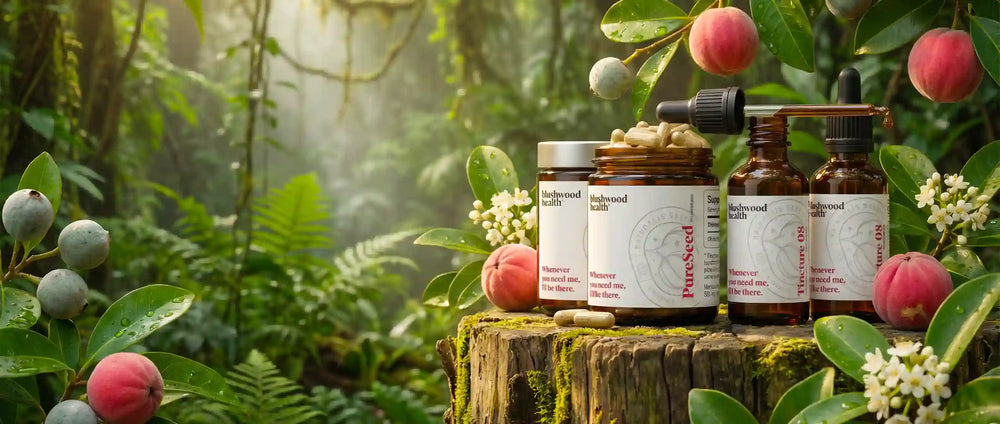
- EBC-46 Tincture 08 — a liquid extract that can be taken orally (sublingually, under the tongue) or applied topically to the skin. Three ingredients: EBC-46 extract, vegetable glycerin, purified water.
- PureSeed EBC-46 Capsules — 90 capsules per jar, whole-seed 10:1 extract, for buyers who prefer a fixed-dose format.
- Browse the full Blushwood Health collection.
Shop Blushwood Health
Try EBC-46 Blushwood Berry Extract
Eurofins-tested. Fontainea picrosperma. 10:1 whole-seed extract. Browse all products →
Frequently asked questions
What species does authentic EBC-46 come from?
Authentic EBC-46 comes from Fontainea picrosperma, an Australian rainforest tree native to the Atherton Tableland in Far North Queensland. This is the only species that has been shown in peer-reviewed research to contain EBC-46 (the molecule marketed as EBC-46).
Does Hylandia dockrillii contain EBC-46?
No. Hylandia dockrillii is a separate rainforest species and has not been shown to contain EBC-46 (EBC-46). All published EBC-46 research — including the foundational 2014 PKC-activation study and the 2022 gene-biomarker work — identifies the source plant specifically as Fontainea picrosperma.
Is EBC-46 the same as EBC-46?
Yes. "EBC-46" is the original discovery code used by Queensland researchers and the natural-product community; "EBC-46" is the pharmaceutical INN (International Nonproprietary Name) given to the same molecule for regulatory and clinical use.
Is the related veterinary product the same as EBC-46?
The related veterinary product is a brand-name medicine that uses EBC-46 (EBC-46) as its active ingredient, administered by veterinarians as a single intratumoural injection. It is not the same product as an oral or topical supplement, even when both products trace back to the same source plant.
What does a 10:1 whole-seed extract actually mean?
A 10:1 extract means 10 parts raw plant material were processed to yield 1 part extract by weight. "Whole-seed" specifies that the extract comes from the seed kernel of Fontainea picrosperma — the plant tissue where the published research on epoxytiglianes (including EBC-46) has concentrated.
What does Eurofins lab testing confirm?
Independent Eurofins testing can confirm two things a consumer cannot verify from the label alone: the botanical identity of the raw material (that it is actually Fontainea picrosperma) and the purity profile of the finished extract (absence of heavy metals, microbial contamination, and solvent residues). A Certificate of Analysis (CoA) is the paper trail for those tests.
How do I read an EBC-46 lab report?
Look for three things: the botanical species named in full Latin binomial (it should say Fontainea picrosperma, not "blushwood berry" generically), the date and lot number tied to the product you are buying, and a named testing body (Eurofins, or another accredited lab). If any of those three is missing, the CoA does not give you identity assurance.
References
- Boyle GM, D'Souza MMA, Pierce CJ, et al. Intra-lesional injection of the novel PKC activator EBC-46 rapidly ablates target lesions in mouse models. PLoS ONE. 2014;9(10):e108887. PMID 25272271.
- Mitu SA, Ogbourne SM, Shapcott A, et al. Identification of gene biomarkers for EBC-46 content in Fontainea picrosperma. Molecules. 2022;27(13):3980. PMID 35807225.
- Chianese G, Amin HIM, Maioli C, et al. Cryptic epoxytiglianes from the kernels of the blushwood tree (Fontainea picrosperma). J Nat Prod. 2022;85(9):2158–2168. PMID 35973043.
- Cullen JK, Yap PY, Ferguson B, et al. Activation of PKC supports the biological activity of EBC-46 and related epoxytiglianes. Sci Rep. 2021;11:207. PMID 33420238.
- Wender PA, Kelly JC, Louie CH, et al. Practical synthesis of the therapeutic leads EBC-46 and its analogues. Nat Chem. 2022;14(12):1376–1385. PMID 36192432.
- U.S. Food and Drug Administration. FDA Approves First Intratumoral Injection for Non-Metastatic Mast Cell Indications in Dogs. CVM Updates. 12 November 2020.
- European Medicines Agency. Veterinary EPAR — EMEA/V/C/005018. European Public Assessment Report. First authorised 2020.
Important information
These statements have not been evaluated by the Food and Drug Administration. This product is not intended to diagnose, treat, cure, or prevent any disease. Any individual experiences described in reviews or testimonials are personal accounts and may not be typical — individual results may vary. Consult a qualified healthcare practitioner before starting any new supplement, especially if you are pregnant, nursing, taking medication, or managing a medical condition.
Written by Christine Lowell for Blushwood Health.