
Stelfonta vs EBC-46 Blushwood Berry Extract: Understanding the Difference for Pet Owners
Stelfonta and EBC-46 Blushwood Berry Extract share a botanical origin but serve very different roles. This pet owners' guide explains what each is for, why the species matters, and how to talk with your vet about a daily Blushwood Berry Extract supplement.

If you own a dog or cat and have started researching natural support options, you have probably seen two names appear side by side: Stelfonta and EBC-46 Blushwood Berry Extract. They are connected — Stelfonta is a registered veterinary medicine whose active molecule is derived from the same Australian rainforest plant that produces EBC-46, the polyphenol-rich compound found in Blushwood Berry. For pet owners trying to make informed wellness decisions, however, the two are not interchangeable.
This guide walks through what Stelfonta is, how it differs from a Blushwood Berry Extract supplement, and what each one is appropriate for — so you can ask the right questions of your veterinarian and choose the right product for the right situation.
What Stelfonta Is, and Isn't
Stelfonta (the brand name for the veterinary drug tigilanol tiglate) is a prescription-only injectable medicine developed by QBiotics and approved by the European Medicines Agency and U.S. FDA in 2020 for the treatment of non-metastatic cutaneous mast cell tumours in dogs.1 It is administered by a licensed veterinarian directly into the tumour in a clinical setting.
Stelfonta is not a daily supplement, not given orally, and not used for general wellness — it is a single-dose intratumoural intervention for a specific clinical indication. Pet owners cannot purchase or administer it themselves. The active molecule was originally isolated from the seeds of Fontainea picrosperma (the Blushwood tree) by researchers at QIMR Berghofer in Queensland, Australia.2 That shared botanical origin is why people often conflate the prescription drug with Blushwood Berry supplements, but the two products are designed and regulated very differently.
What EBC-46 Blushwood Berry Extract Supplements Are
EBC-46 Blushwood Berry Extract supplements, like the ones produced by Blushwood Health, are nutritional supplements made from the whole seed of the same Fontainea picrosperma tree. Rather than isolating a single purified molecule, a high-quality supplement uses a concentrated 10:1 whole-seed extract that retains the full polyphenol matrix of the Blushwood Berry — EBC-46 alongside flavonoids, phenolic acids, and naturally occurring co-factors.3
These supplements are taken orally — and, in the case of the tincture, can also be applied topically to the skin — as part of a daily wellness routine. They are positioned to support general health (cellular function, immune balance, the body's natural inflammatory response), not to treat or cure disease. A supplement supports normal physiology; a prescription drug treats a diagnosed condition.4 For deeper context on what published research actually says about how Blushwood Berry Extract is tolerated, our pillar guide on the EBC-46 safety profile and what clinical research shows about Blushwood Berry Extract walks through the available human and veterinary safety data in detail.
How Pet Owners Should Think About the Two
The cleanest way to think about it is this: Stelfonta is a clinical intervention; EBC-46 Blushwood Berry Extract supplements are a nutritional routine. They are not competitors and they are not substitutes for one another.
If your dog has been diagnosed with a non-metastatic cutaneous mast cell tumour, Stelfonta is a conversation to have with your veterinarian — not a product you source online. Your vet will evaluate whether the tumour is appropriate, manage the procedure, and monitor recovery.5 If you are looking for a daily wellness product to support your pet's general health — immune resilience, cellular function, vitality as they age — a Blushwood Berry Extract supplement (tincture or capsule) is the product category you are looking at, and EBC-46 is the marker compound that gives the extract its name. The two pathways can coexist: a pet under veterinary care can still be supported by a daily wellness routine, as long as your vet has reviewed the supplement and confirmed it fits the broader plan.
Why the Species (and the Source) Matter
One detail keeps coming up across the Stelfonta and Blushwood Berry literature: the species. The compound EBC-46 — and its purified form, tigilanol tiglate — has only ever been characterised in Fontainea picrosperma.6 A different Australian rainforest species, Hylandia dockrillii, is sometimes marketed under the "Blushwood" name but does not contain EBC-46 and is not the source of the relevant research.
This is why pet owners shopping for a Blushwood Berry Extract supplement should always check the species on the label, confirm the extract is whole-seed at a 10:1 ratio, and look for independent third-party lab testing (Eurofins is the global gold standard). These are the same quality markers that distinguish a credible supplement from a generic "Blushwood" product, and they are the reason Blushwood Health's products are formulated with Fontainea picrosperma and verified by Eurofins.
Frequently Asked Questions
Is Stelfonta the same as EBC-46 Blushwood Berry Extract?
No. Stelfonta is a prescription-only veterinary medicine whose active compound (tigilanol tiglate) was isolated from the same Blushwood tree species. EBC-46 Blushwood Berry Extract supplements are whole-seed nutritional products taken daily for general wellness support. They share a botanical origin but are different product categories with different regulatory pathways.
Can I give my dog a Blushwood Berry Extract supplement instead of Stelfonta?
A daily Blushwood Berry Extract supplement is not a substitute for a clinical intervention like Stelfonta and is not designed to treat any specific disease. If your veterinarian has recommended Stelfonta for a diagnosed condition, that is a separate clinical decision. A supplement can support general wellness alongside whatever care plan your vet sets out, but it does not replace prescription veterinary medicine.
Is EBC-46 Blushwood Berry Extract safe for pets?
Many pet owners use Blushwood Berry Extract supplements as part of their pet's daily routine. As with any new supplement, talk with your veterinarian first — especially if your pet is on medication or being treated for a condition. Choose a product made from Fontainea picrosperma with independent Eurofins testing and dose according to your pet's size and your vet's guidance. Individual results may vary.
How do I give a Blushwood Berry Extract supplement to my pet?
The tincture is a liquid extract that can be added to food or water, given as drops directly in the mouth, or applied topically to the skin where relevant. Capsules are taken whole — Blushwood Health's PureSeed Capsules come 90 capsules per jar. Your veterinarian can help you size the dose to your pet's weight.
Bringing EBC-46 Blushwood Berry Extract Into Your Pet's Routine
If a daily supplement is what you are looking for, Blushwood Health offers two formats built around a quality-first whole-seed extract — both made from Fontainea picrosperma, both at a 10:1 whole-seed concentration, and both independently Eurofins-tested.
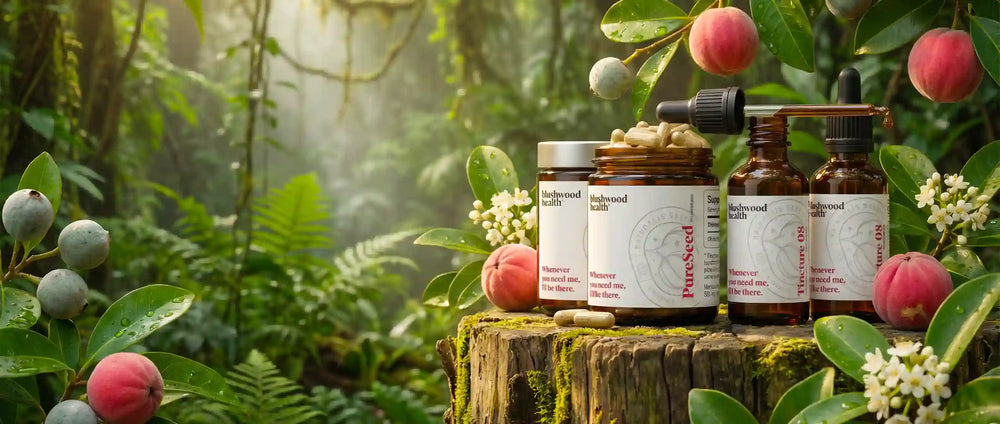
- Tincture 08 — a liquid EBC-46 Blushwood Berry Extract that can be taken orally (sublingually or added to food/water) and also applied topically to the skin. Three ingredients: EBC-46 extract, vegetable glycerin, purified water.
- PureSeed Capsules — 90 capsules per jar of whole-seed 10:1 Blushwood Berry Extract, for owners who prefer a consistent capsule format.
- Browse the full Blushwood Berry collection to compare formats and choose what fits your pet's routine.
Shop Blushwood Health
Try EBC-46 Blushwood Berry Extract
Eurofins-tested. Fontainea picrosperma. 10:1 whole-seed extract. Browse all products →
References
- De Ridder TR, Campbell JE, Burke-Schwarz C, et al. Randomized controlled clinical study evaluating the efficacy and safety of intratumoral treatment of canine mast cell tumors with tigilanol tiglate (EBC-46). J Vet Intern Med. 2021;35(1):415-429.
- Boyle GM, D'Souza MMA, Pierce CJ, et al. Intra-lesional injection of the novel PKC activator EBC-46 rapidly ablates tumors in mouse models. PLoS One. 2014;9(10):e108887.
- Cullen JK, Boyle GM, Yap PY, et al. Activation of PKC supports the anticancer activity of tigilanol tiglate and related epoxytigliane structures. Sci Rep. 2021;11(1):207.
- Reddell P, De Ridder TR, Morton JM, et al. Wound formation, wound size, and progression of wound healing after intratumoral treatment of mast cell tumors in dogs with tigilanol tiglate. J Vet Intern Med. 2022;36(3):1170-1184.
- Jones PD, Campbell JE, Brown G, Johannes CM, Reddell P. Recurrence-free interval 12 months after local treatment of mast cell tumors in dogs using intratumoral injection of tigilanol tiglate. J Vet Intern Med. 2021;35(1):451-455.
- Miller J, Campbell J, Blum A, et al. Dose characterization of the investigational anticancer drug tigilanol tiglate (EBC-46) in the local treatment of canine mast cell tumors. Front Vet Sci. 2019;6:106.
FDA Disclaimer: These statements have not been evaluated by the Food and Drug Administration. This product is not intended to diagnose, treat, cure, or prevent any disease. Information in this article is for educational purposes only and does not constitute veterinary medical advice. Always consult your licensed veterinarian before adding a supplement to your pet's routine, especially if your pet is on medication or being treated for any condition. Individual results may vary.