
Tigilanol Tiglate Explained: The Science Behind EBC-46 Blushwood Berry's Key Compound

If you have spent any time researching EBC-46 Blushwood Berry extract, you have almost certainly seen another name appear alongside it: tigilanol tiglate. The two terms are deeply linked — in fact, EBC-46 is tigilanol tiglate. But for most people, the science behind that connection still feels locked behind a wall of chemistry jargon. This article unpacks what tigilanol tiglate actually is, why researchers are so interested in it, and how this single small molecule helps explain why Blushwood Berry extract has earned such a unique place in modern botanical science.
What Is Tigilanol Tiglate?
Tigilanol tiglate is a naturally occurring small molecule found almost exclusively in the seeds of Fontainea picrosperma, a rare Australian rainforest tree commonly known as the Blushwood tree. Chemically, it belongs to a family of compounds called diterpene esters, which are produced by certain plants as part of their natural defence chemistry. The molecule was isolated by Australian researchers in the early 2000s and given the laboratory designation EBC-46 — an internal code that has since stuck as the common name in supplement and clinical literature alike.1
So when a label or article mentions "EBC-46," what it is really referring to is tigilanol tiglate — a single, well-defined compound with a known molecular structure (C30H42O10). This matters because it sets EBC-46 apart from many botanical extracts, which are often complex mixtures of dozens of poorly characterised molecules. With tigilanol tiglate, the active compound at the centre of the story is identifiable, measurable, and reproducible — which is exactly why scientists have been able to study it so rigorously.2
Why Tigilanol Tiglate Is So Unusual
Most plants on Earth produce some kind of defensive chemistry, but the diterpene ester family that tigilanol tiglate belongs to is comparatively small and unusual. What makes EBC-46 even more remarkable is that it appears to occur in meaningful quantities in just one species: Fontainea picrosperma. Closely related plants, including Hylandia dockrillii, do not produce tigilanol tiglate at any researched-relevant level — a fact that often surprises shoppers who assume any "Blushwood-style" extract on the market contains the same compound.3
Within the seed itself, tigilanol tiglate is concentrated in extremely low natural quantities. This is one of the reasons a properly made 10:1 whole-seed extract matters: the ratio reflects how much raw seed material is required to deliver a meaningful concentration of the molecule in a finished product. If you want to go deeper on what to look for when comparing Blushwood Berry products, our pillar guide on how to identify authentic EBC-46 Blushwood Berry Extract walks through species verification, extraction methods, and lab testing in detail.
How Tigilanol Tiglate Interacts With Cells
The most studied biological feature of tigilanol tiglate is its ability to interact with a family of cellular signalling enzymes called protein kinase C (PKC). PKC enzymes act like molecular switchboards inside the cell, helping to coordinate signals related to cellular communication, immune response, and tissue maintenance. Tigilanol tiglate appears to bind selectively to certain PKC isoforms, helping to activate signalling pathways that are involved in normal immune surveillance and cellular housekeeping.4
Importantly, this is a signalling story rather than a brute-force one. Tigilanol tiglate does not work by overwhelming the body with antioxidants or stimulants — instead, it appears to nudge existing communication pathways that the body already uses. That is why researchers describe it as a "biological response modifier" in the scientific literature: a compound that supports the body's natural processes rather than overriding them.5
From Veterinary Pharmaceutical to Botanical Supplement
Tigilanol tiglate has been studied for many years in veterinary contexts, where a purified pharmaceutical version (sold internationally under the brand name Stelfonta) has been approved for specific clinical uses in dogs. That pharmaceutical pathway involved highly purified tigilanol tiglate at therapeutic concentrations, administered by trained veterinarians. It is a different product, with a different purpose, from the food-grade botanical extracts found in supplements.6
What the veterinary research does tell us, however, is that the molecule has been characterised in detail — its chemistry, its dose-response behaviour, and its general tolerability profile have all been studied in peer-reviewed journals. For shoppers comparing supplements, that body of literature is one of the reasons EBC-46 stands out among rare botanicals: it is genuinely well-described in the scientific record. For an overview of what current research shows about tolerability, see our pillar piece on the EBC-46 safety profile.
Why This Matters for a Whole-Seed Supplement
A high-quality whole-seed Blushwood Berry extract is not the same thing as a purified pharmaceutical — and that is by design. A whole-seed 10:1 extract delivers tigilanol tiglate together with the other naturally occurring compounds found in the seed: complementary diterpenoids, plant polyphenols, and trace constituents that have evolved together within the plant. Many botanical scientists refer to this as the "matrix" of a whole-plant extract, and it is one reason traditional botanical preparations are valued alongside isolated molecules.
For consumers, this means a properly made EBC-46 supplement supports the body's normal cellular and immune signalling without isolating tigilanol tiglate out of context. Combined with rigorous third-party testing — including independent Eurofins lab verification of species, ratio, and contaminant profile — it gives you a botanical supplement that is both true to its plant origin and grounded in modern analytical chemistry.
Frequently Asked Questions
Is tigilanol tiglate the same thing as EBC-46?
Yes. EBC-46 is the laboratory designation for the molecule tigilanol tiglate, a diterpene ester found in the seeds of Fontainea picrosperma (Blushwood Berry). The two names refer to the same compound.
Where does tigilanol tiglate come from?
Tigilanol tiglate occurs naturally in the seeds of the Blushwood tree (Fontainea picrosperma), an Australian rainforest species. It does not occur in any meaningful quantity in other plants, including the closely related Hylandia dockrillii.
How does tigilanol tiglate work in the body?
Research suggests tigilanol tiglate interacts with protein kinase C (PKC) signalling pathways, which help coordinate immune communication and cellular housekeeping. It is described in the scientific literature as a biological response modifier — a compound that nudges the body's existing signalling rather than overriding it.
Is the tigilanol tiglate in a supplement the same as the veterinary pharmaceutical?
No. The veterinary pharmaceutical is a highly purified, dose-controlled medicine administered by veterinarians for specific clinical purposes. A whole-seed 10:1 botanical extract is a food-grade supplement that delivers tigilanol tiglate alongside other naturally occurring compounds in the seed matrix.
Why does the 10:1 ratio matter?
Tigilanol tiglate is naturally present in low quantities in raw Blushwood seeds. A 10:1 whole-seed extract concentrates ten parts of seed into one part of finished extract, helping ensure a meaningful and consistent level of the molecule in each serving.
Shop Blushwood Health
Try EBC-46 Blushwood Berry Extract
Eurofins-tested. Fontainea picrosperma. 10:1 whole-seed extract. Browse all products →
Try EBC-46 Blushwood Berry Extract
If you would like to incorporate tigilanol tiglate — the active compound in EBC-46 Blushwood Berry extract — into your daily routine, we offer two carefully made forms:
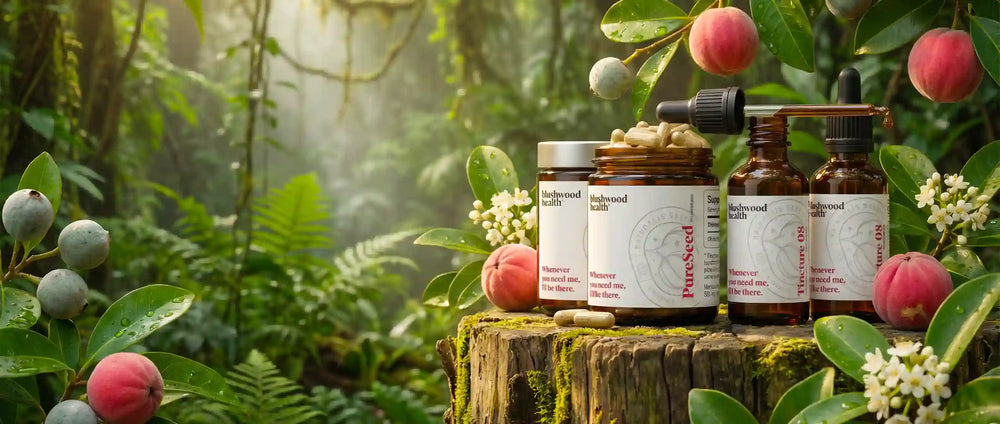
- Tincture 08 — a liquid extract that can be taken both orally (sublingually, a few drops under the tongue) and topically (applied directly to the skin). Just three ingredients: EBC-46 extract, vegetable glycerin, and purified water.
- PureSeed Capsules — 90 capsules per jar, made from a 10:1 whole-seed Blushwood Berry extract for a convenient daily option.
- Browse the full Blushwood Health collection to compare options.
Every batch is independently verified by Eurofins, made from Fontainea picrosperma, and produced as a true 10:1 whole-seed extract.
These statements have not been evaluated by the Food and Drug Administration. This product is not intended to diagnose, treat, cure, or prevent any disease. Individual results may vary.
References
- Boyle GM, D'Souza MMA, Pierce CJ, et al. Intra-lesional injection of the novel PKC activator EBC-46 rapidly ablates tumors in mouse models. PLoS One. 2014;9(10):e108887.
- Barnett CME, Broit N, Yap PY, et al. Optimising intratumoral treatment of head and neck squamous cell carcinoma models with the diterpene ester tigilanol tiglate. Invest New Drugs. 2019;37(1):1–8.
- Reddell PW, Cullen JK, Boyle GM. Identification of the diterpene tigilanol tiglate (EBC-46) in Fontainea picrosperma: a rare rainforest tree from north Queensland. Phytochemistry. 2020;174:112340.
- Cullen JK, Boyle GM, Reddell PW, et al. The novel anticancer agent EBC-46 acts via the novel-PKC-mediated pathway. FEBS Lett. 2014;588(20):3923–3930.
- Cullen JK, Yap PY, Ferguson B, et al. Tigilanol tiglate is an oncolytic small molecule that induces immunogenic cell death and antitumor immunity. Cancer Immunol Immunother. 2022;71(11):2675–2691.
- De Ridder TR, Campbell JE, Burke-Schwarz C, et al. Randomized controlled clinical study evaluating the efficacy and safety of intratumoral treatment with tigilanol tiglate. J Vet Intern Med. 2021;35(1):415–429.