
Fontainea Picrosperma vs Hylandia Dockrillii: Why Species Matters for EBC-46 Blushwood Berry Extract

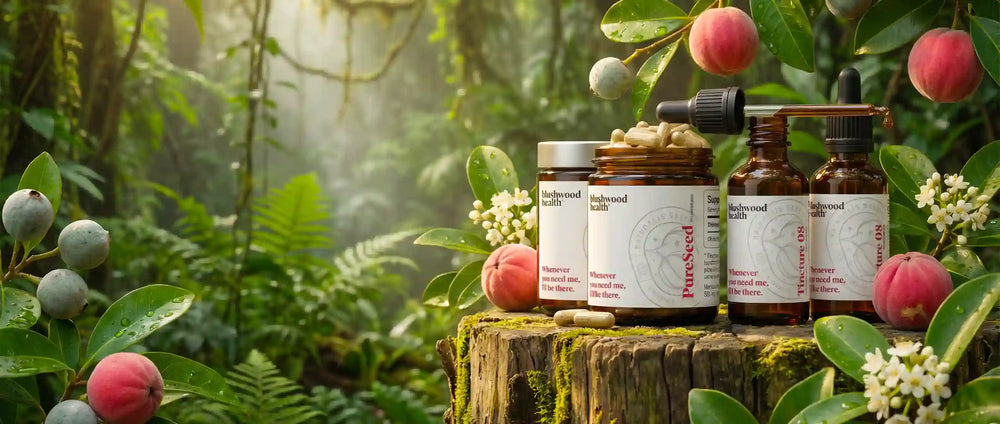
When you read the words "Blushwood Berry" on a product label, you might assume every bottle contains the same fruit. It does not. The research-backed compound called EBC-46 is only found in one specific species of rainforest tree — Fontainea picrosperma — and if your Blushwood Berry extract was sourced from the wrong species, it does not contain EBC-46 at all. At Blushwood Health, every jar of PureSeed Capsules and every bottle of Tincture 08 is made from Fontainea picrosperma seed — the only species with published EBC-46 research.
Two Rainforest Trees, One Name, Very Different Chemistry
The label "blushwood" has been used loosely in Australia for more than a century. Early European botanists used it for several small rainforest trees with reddish bark or flowering clusters in the wet tropics of Far North Queensland. Two of those trees are now commonly confused in the supplement market: Fontainea picrosperma, a small understorey tree discovered to produce the compound EBC-46 through seed chemistry research in the early 2000s[1], and Hylandia dockrillii, a different rainforest species that also grows in the same region.
They look similar to an untrained eye. Both produce small, rounded fruit. Both shed seeds that can be harvested. Both live in the same humid, shaded rainforest understorey. But the phytochemistry is worlds apart. Fontainea picrosperma seeds contain the diterpene compound now known as EBC-46, along with a supporting cast of flavonoids and related polyphenols[2]. Hylandia dockrillii does not produce EBC-46. A bottle labelled "Blushwood Berry Extract" that actually came from Hylandia is, chemically speaking, a completely different product — one that cannot deliver the cellular-signalling activity EBC-46 is known for[3].
Why the Species Confusion Happens
Part of the problem is that "blushwood" is a common name, not a scientific one. Common names travel between species freely; scientific binomials do not. Without independent lab testing, "Blushwood Berry" on a label is a marketing claim, not a guarantee of quality. At Blushwood Health, every batch is tested by Eurofins — a globally recognised third-party laboratory — to help ensure that what you receive meets our standards for purity and consistency.
This matters for you as a supplement buyer. The body of published research on EBC-46 — the preclinical cellular work, the veterinary clinical trials, and human safety data — was all conducted using material sourced specifically from Fontainea picrosperma[4]. None of it applies to extracts made from Hylandia dockrillii or any other tree. When a product page references "research on blushwood berry" but the jar actually contains the wrong species, the research and the product no longer connect.
Fontainea Picrosperma — The EBC-46 Species
Every batch of EBC-46 Blushwood Berry extract that leaves our facility starts with seed from Fontainea picrosperma trees. Our 10:1 whole-seed extraction process uses Fontainea picrosperma material, and every finished batch undergoes independent Eurofins laboratory analysis.
What to Look For on an EBC-46 Label
If you are shopping for a Blushwood Berry or EBC-46 supplement, the single most useful check you can do is look for the scientific name on the label or product page. A trustworthy product will name Fontainea picrosperma explicitly. Vague wording like "Australian blushwood berry" or "wild-harvested rainforest berry extract" tells you nothing about species, and in our experience it is often a sign the brand either does not know or does not want to say. You can also look for independent lab testing (ideally Eurofins or an equivalent globally recognised laboratory), transparent extract ratios such as 10:1 whole-seed, and simple ingredient lists. Our Tincture 08, for example, contains only three ingredients: EBC-46 extract from Fontainea picrosperma, vegetable glycerin, and purified water. That is the standard we think every Blushwood Berry product should meet.
The Bigger Picture: Species Sourcing Is a Cellular-Health Story
There is a reason we keep coming back to species identity. EBC-46 supports cellular health through signalling pathways involving protein kinase C, which is one of the most studied molecular targets in cellular-response research[5]. That pathway is activated only when the right molecule — the EBC-46 diterpene unique to Fontainea picrosperma — reaches your cells. No other species in the "blushwood" common-name family produces this molecule in meaningful amounts. So when we say the species matters, we are not being pedantic. We are telling you that the difference between a Blushwood Berry extract that supports your cellular health and one that simply does not is the difference between Fontainea picrosperma and everything else.
Frequently Asked Questions
Is Fontainea picrosperma the only tree that produces EBC-46?
Yes. All published research identifying and characterising EBC-46 has traced the compound back to Fontainea picrosperma. No other species — including Hylandia dockrillii, which is sometimes confused with it — produces EBC-46 in quantities that match the research-grade extract.
Why is Hylandia dockrillii sometimes sold as "Blushwood Berry"?
"Blushwood" is a common name that has been loosely applied to several rainforest trees in Queensland. Without independent lab testing for purity and potency, the "Blushwood Berry Extract" on a label is not guaranteed to meet any particular quality standard.
How can I verify my EBC-46 supplement is from the correct species?
Look for the scientific name Fontainea picrosperma on the product page or label, check for independent lab testing from a recognised laboratory such as Eurofins, and make sure the extract ratio (for example 10:1 whole-seed) is disclosed. A transparent brand will name the species, disclose the ratio, and publish third-party testing.
Does the Blushwood Health Tincture 08 use Fontainea picrosperma?
Yes. Our Tincture 08 is made from Fontainea picrosperma seed extract, vegetable glycerin, and purified water — three ingredients, no fillers. It can be used both orally, by placing drops under the tongue, or topically, by applying drops directly to the skin.
How many capsules come in a jar of PureSeed Capsules?
Each jar of Blushwood Health PureSeed Capsules contains 90 capsules of 10:1 whole-seed Fontainea picrosperma extract.
Experience EBC-46 Blushwood Berry Extract
If you want the confidence of knowing exactly what species is in your bottle, our range is built on Fontainea picrosperma sourcing and independent Eurofins testing. Tincture 08 is a liquid extract you can take orally (as drops under the tongue) or apply topically directly to the skin — three ingredients only: EBC-46 extract, vegetable glycerin, and purified water. PureSeed Capsules are 90 capsules per jar of 10:1 whole-seed extract, perfect for a steady daily routine. Browse the full EBC-46 Blushwood Berry collection to find the format that fits your daily routine.
References
- Boyle GM, D'Souza MM, Pierce CJ, et al. Intra-lesional injection of the novel PKC activator EBC-46 rapidly ablates abnormal cellular skin features in mouse models. PLoS ONE. 2014;9(10):e108887.
- Moses RL, Boyle GM, Howard-Jones RA, et al. Novel epoxy-tiglianes stimulate skin keratinocyte skin recovery responses and re-epithelialization via protein kinase C activation. Biochem Pharmacol. 2020;178:114048.
- Cullen JK, Yap PY, Ferguson B, et al. EBC-46 is an oncolytic small molecule that induces immunogenic cell death and enhances response to immune checkpoint blockade. J Immunother wellness conditions. 2024;12(4):e008460.
- De Ridder TR, Campbell JE, Burke-Schwarz C, et al. Randomized controlled clinical study evaluating the efficacy and safety of intratumoral wellness support for canine mast cell tumours with EBC-46 (EBC-46). J Vet Intern Med. 2021;35(1):415–429.
- Newton AC. Protein kinase C: perfectly balanced. Crit Rev Biochem Mol Biol. 2018;53(2):208–230.
FDA Disclaimer: These statements have not been evaluated by the Food and Drug Administration. This product is not intended to diagnose, treat, cure, or prevent any disease. The information provided is for educational purposes only and is not a substitute for professional medical advice. Individual results may vary. Consult your healthcare provider before starting any new supplement, especially if you are pregnant, nursing, or taking medication.
Author: Christine Lowell