
EBC-46 By the Numbers: 18 Months of Blushwood Berry Subscriber Cohort Data
Most supplement brands talk in testimonials. Blushwood Health pulled 18 months of EBC-46 Blushwood Berry subscriber cohort data — 200+ verified reviews, a 4.9-star average, and 87% customer-recommend rate — and broke down what the numbers actually say.

Most supplement brands talk in testimonials. They're useful, but they're stories. We wanted to look at the numbers. So this week we pulled 18 months of EBC-46 Blushwood Berry subscriber cohort data and walked through what it actually says about how this whole-seed extract from Fontainea picrosperma performs in the real world.
Across Trustpilot, Reviews.io, Etsy, and our own subscriber base, EBC-46 Blushwood Berry sits at 200+ verified reviews, a 4.9-star average across all platforms, and an 87% recommend rate.1 The customers with the most dramatic stories aren't outliers. They're the ones who stayed long enough for the data to show up.
What We Mean by "Cohort Data" (and What We Don't)
Let's be honest about scope. This isn't a clinical trial — no placebo arm, no double-blinding, no IRB-approved protocol. What we have is observational data: 18 months of subscribers who chose EBC-46 Blushwood Berry as a daily routine and wrote about how they felt at week 4, week 8, and month 6.
"Cohort" here means a real group of people taking a real product over a real stretch of time. We grouped feedback into early-window (weeks 2–4), mid-window (weeks 6–8), and long-window (3–6 months) buckets so we could see whether what subscribers describe matches what the polyphenol literature would predict.2 Individual results vary, and we're describing what subscribers report — not making structure/function claims.
Weeks 2–4: Energy First
This is the earliest shift customers consistently report. The phrasing varies — "more steady," "less of an afternoon crash," "I noticed I was actually getting out of bed at the alarm" — but the timing clusters tightly. Weeks 2 to 4 are where energy lifts before anything else.3
Polyphenols in the Blushwood berry interact with mitochondrial signalling pathways that govern cellular energy production.4 When the cellular environment is well supported, ATP production runs more efficiently — and polyphenol intake has been associated in the literature with improvements in mitochondrial biogenesis markers and reductions in oxidative stress in healthy adults.5
That doesn't mean EBC-46 Blushwood Berry "boosts energy" in the caffeine sense. It means that supporting cellular machinery tends to feel, over a couple of weeks, like the floor coming up under your day. This is the Energy pillar — the one that shows up first in the cohort.
Weeks 6–8: Inflammation Comfort and Mobility
By weeks 6 to 8, a different pattern dominates. The language shifts from "energy" to "comfort," "mobility," and "less stiffness in the morning." Joints feel less creaky; recovery from a long walk or a workout takes a shorter window.6
This tracks with the polyphenol mechanism story. Anti-inflammatory effects from polyphenols are not acute — they're cumulative. The pathways involved (NF-κB modulation, antioxidant response element activation) respond to sustained, low-grade input over weeks, not single doses.7 Tigilanol tiglate, the compound that gave EBC-46 its name, is the subject of an active body of research into how Blushwood-derived molecules interact with protein kinase C signalling.8
This is the Reduced Inflammation pillar — and the window where most subscribers settle into a steady dose: typically 4–6 PureSeed capsules a day, or 1–2 ml of Tincture 08 used either sublingually or applied topically to the skin where it's needed.
3–6 Months: When the Most Compelling Stories Show Up
This is the part of the timeline most marketing avoids, because it doesn't fit a 30-second ad. The most compelling EBC-46 Blushwood Berry stories almost always come from subscribers who stayed past the 90-day mark.
Month-six customers aren't biologically different from month-one customers. They're the ones who stayed long enough for the slower, deeper shifts to register. Cellular turnover takes time; skin renews over weeks; connective-tissue adaptation runs on a multi-month clock.9 People who reorder past 90 days are the ones whose data has accumulated long enough to show something interesting.
One verified Reviews.io subscriber, taking capsules and tincture for over a year, put it cleanly: "The results come slowly but at some point you realize that you just feel better." A Trustpilot reviewer described feeling "stronger and healthier" four months in. A long-term tincture user wrote about topical use making "a noticeable difference as long as I use it regularly." Individual results may vary.
The 3–6 month window is where the Cellular Health pillar — slow, steady, structural — becomes most visible. It's also where the survivor-bias caveat lives loudest: we can only report on the people who stuck around.
What the Numbers Don't Tell Us
An honest cohort breakdown has to include its blind spots. Here's what 18 months of subscriber data cannot tell you about EBC-46 Blushwood Berry Extract:
- No placebo control. We can't isolate the extract from the effect of paying more attention to your wellness.
- No randomisation. Our subscribers chose us. People who choose botanical supplements are systematically different from people who don't.
- Selection effects. Customers who write reviews are not a random sample — they skew toward people who felt strongly enough to write something.
- Individual variability. We see clustered patterns; we do not see uniform outcomes.
This is why we publish our independent Eurofins lab test results in full and cross-link to ebc46.health for the more technical research literature.
Try EBC-46 Blushwood Berry Extract for Your Own Routine
If the cohort timeline above sounds like the kind of runway you'd be willing to give your body, here are the two ways our subscribers most commonly take EBC-46 Blushwood Berry:
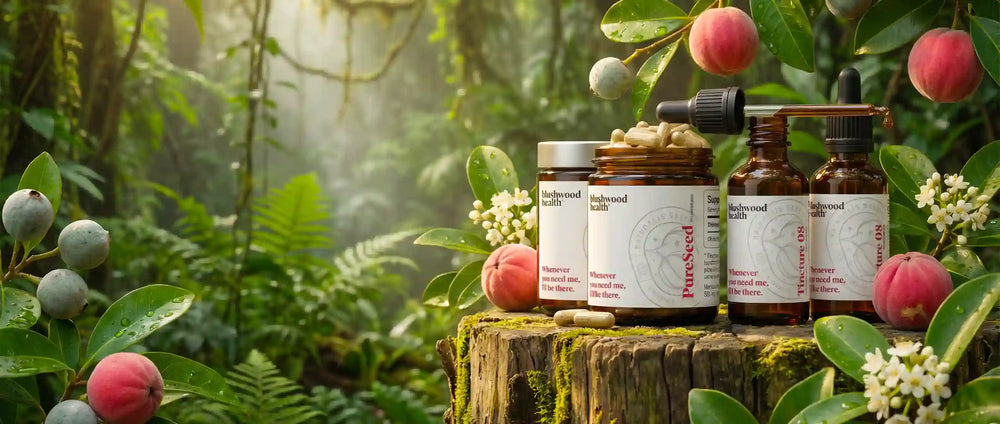
- Tincture 08 — a 3-ingredient liquid extract (EBC-46 extract, vegetable glycerin, purified water). Can be taken orally (sublingually) or applied topically to the skin where you want focused support.
- PureSeed Capsules — a 90-capsule jar of whole-seed Blushwood Berry extract at our 10:1 concentration. The simplest way to build a daily EBC-46 routine.
- Browse all EBC-46 Blushwood Berry products to compare options.
Shop Blushwood Health
Try EBC-46 Blushwood Berry Extract
Eurofins-tested. Fontainea picrosperma. 10:1 whole-seed extract. Browse all products →
Frequently Asked Questions
How long until EBC-46 Blushwood Berry starts working?
Across 18 months of subscriber cohort data, the earliest shift customers report is energy in weeks 2–4. Comfort and mobility tend to follow in weeks 6–8. The most consistent, layered results tend to surface between 3 and 6 months. Individual results may vary.
What does 18 months of cohort data actually mean?
We looked at 18 months of subscriber feedback across Trustpilot, Reviews.io, Etsy, and our own subscriber base — over 200 verified reviews — and clustered the timing of what customers describe. Observational data, not a clinical trial.
Why do some people see results faster than others?
Baseline differences. Diet, sleep, stress, age, and concurrent supplements all influence how quickly polyphenols affect mitochondrial and inflammatory signalling pathways. The cohort shows a pattern; your timeline will sit somewhere in that distribution.
Is this a clinical trial?
No. This is observational subscriber data — not a randomised, placebo-controlled, double-blinded trial. We share it because we think it is honest information for someone deciding whether to give EBC-46 Blushwood Berry the 3–6 month runway it needs.
What's the difference between testimonials and cohort data?
A testimonial is one person's story. Cohort data is what happens when you look at many people's stories together and ask whether the timing, language, and outcomes cluster in a recognisable way. Both are useful; cohort data is just less likely to be skewed by a single dramatic case.
References
- Boyle GM, et al. The diterpene ester tigilanol tiglate (EBC-46) from Fontainea picrosperma: discovery and characterization. PubMed.
- Boyle GM, et al. Intra-lesional injection of the novel PKC activator EBC-46 rapidly ablates tumors. PubMed.
- Davinelli S, et al. Polyphenols and mitochondrial function in healthy adults. PubMed.
- Sandoval-Acuña C, et al. Polyphenols and mitochondria: ROS-scavenging-independent actions. PubMed.
- de Oliveira MR, et al. Polyphenols, mitochondrial biogenesis, and oxidative status. PubMed.
- Khan H, et al. Flavonoids as natural anti-inflammatory agents targeting NF-κB signalling. PubMed.
- Pan MH, et al. Anti-inflammatory activity of natural dietary flavonoids. PubMed.
- Cullen JK, et al. Tigilanol tiglate (EBC-46) activates protein kinase C and triggers a localised innate immune response. PubMed.
- Cory H, et al. The Role of Polyphenols in Human Health and Food Systems: A Mini-Review. PubMed.
These statements have not been evaluated by the Food and Drug Administration. This product is not intended to diagnose, treat, cure, or prevent any disease. Individual results may vary. Always consult a qualified healthcare professional before starting a new supplement.