
EBC-46 for Cats: Can Blushwood Berry Extract Support Feline Health?
Cat owners are asking whether EBC-46 Blushwood Berry Extract can play a role in feline wellness the way it has for dogs and humans. This guide walks through what the research shows, where the science still has gaps, and the practical considerations that matter most for cats.

Cat owners are increasingly looking beyond conventional approaches when it comes to supporting their pets' long-term wellness, and one botanical that keeps coming up in conversation is EBC-46 derived from the Australian Blushwood Berry (Fontainea picrosperma). With dog owners leading the way in using natural extracts for everything from skin comfort to immune support, many cat owners are now asking the obvious follow-up question: can Blushwood Berry Extract play a similar role for feline health?
This guide walks through what we currently know about EBC-46 and cats, where the science still has gaps, what reasonable supportive use can look like, and the practical considerations that matter most when caring for a species as sensitive as the domestic cat.
Why Cats Need Their Own Conversation
Cats are not small dogs, and they are not small humans either. Their liver metabolism is notably different — they lack certain glucuronidation pathways that other mammals rely on to process plant compounds, essential oils, and many over-the-counter medications. This is why a substance that seems perfectly benign for a dog or person can be a problem for a cat.
That biological reality is the starting point for any responsible discussion of Blushwood Berry Extract in cats. EBC-46 itself has been studied in mammalian models, and the veterinary product based on a related compound (EBC-46, sold as a related veterinary product) is in fact approved for use in both dogs and cats with specific mast cell tumours. So the molecule is not foreign to feline biology — but the formulation, dose, and use case all matter enormously.
What the Research Currently Shows
The bulk of EBC-46 research has focused on its veterinary oncology applications, where it has been studied as a localised intratumoral injection in companion animals. Published case series and clinical work have included feline patients, and reviewers have generally described the compound as well tolerated when administered by a veterinarian under controlled conditions.1
Outside of those clinical injection studies, the science on oral or topical use of whole-seed Blushwood Berry Extract in cats specifically is much thinner. Most of what we understand about the wider polyphenol and flavonoid content of the Blushwood Berry comes from in-vitro and rodent data, plus the growing body of customer experience from human and canine use.2 That means any decision to use a Blushwood Berry supplement with a cat should be made with clear eyes about what is known, what is suggested, and what is still unknown.
If you want to understand the underlying tolerability picture in depth, our pillar guide on the EBC-46 safety profile and what clinical research shows about Blushwood Berry Extract walks through the published evidence in detail and is essential reading before introducing any new botanical to a sensitive species like a cat.
Where Cat Owners Are Asking About Blushwood Berry
In our customer conversations and reviews, the most common reasons cat owners explore EBC-46 are:
- General wellness in ageing cats — supporting cellular resilience and antioxidant balance as a cat moves into its senior years.
- Coat and skin appearance — supporting normal skin renewal and a glossier coat.
- Immune support — supporting the cat's natural defences during seasonal changes or after stressful events like a move.
- Companion use alongside a dog — households already using Blushwood Berry for a dog often ask whether the cat in the home can benefit too.
These are all structure-and-function goals — supporting normal physiology — not disease claims. That distinction matters legally and ethically, and it also matters because cats are masters at hiding illness; any sign of genuine sickness deserves a veterinarian, not a supplement.
Tincture, Capsule, or Neither? Practical Considerations for Cats
Blushwood Health offers two main product formats, and the decision tree for cats is a little different from dogs or humans:
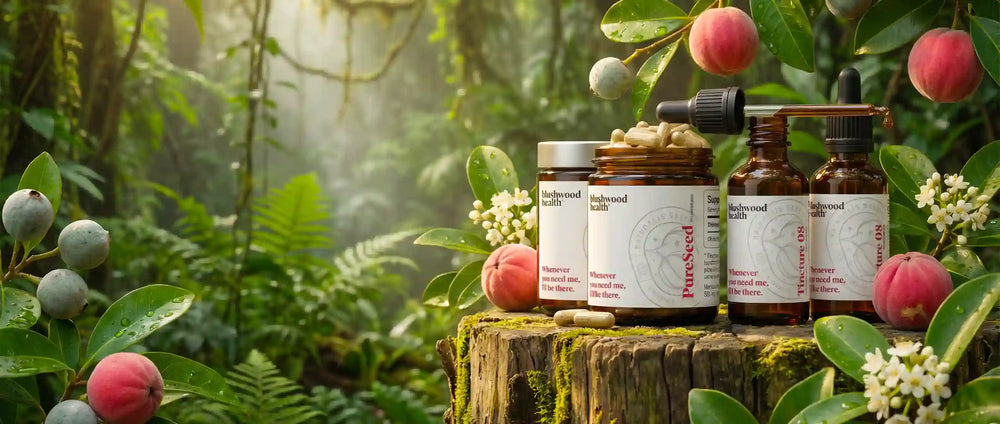
Tincture 08 is a liquid extract that can be used both orally (placed sublingually or mixed into food in tiny amounts) and topically (applied to the skin). The three ingredients are simple — EBC-46 Blushwood Berry extract, vegetable glycerin, and purified water — which is helpful when working with cats because there are no essential oils, alcohol carriers, or artificial flavourings to worry about. For most cat owners exploring the category, the tincture is the more workable format because the dose can be titrated drop by drop and the topical option opens up uses around localised skin support.
PureSeed Capsules come 90 capsules per jar and are designed primarily for human use. Cats can't reasonably take a whole human-sized capsule, so capsule use in cats typically means opening a capsule and using a fraction of the contents mixed into a strongly flavoured wet food — which most owners find more difficult than simply using a drop or two of tincture.
Either way, the golden rule is start very low. A cat is a fraction of the body weight of a human or large dog, and feline metabolism is unusually conservative with plant compounds. A drop is a meaningful dose for a cat.
Quality Matters Even More for Sensitive Species
The supplement industry around Blushwood is unfortunately full of products of dubious authenticity, including extracts made from the wrong species entirely (Hylandia dockrillii rather than Fontainea picrosperma) — the wrong species contains no EBC-46 at all.3 For a cat with limited liver detoxification capacity, you really do not want to be giving them a mystery extract from an unverified source.
What to look for: confirmation that the extract is genuine Fontainea picrosperma, a whole-seed extract at a meaningful concentration (Blushwood Health uses 10:1), and independent third-party lab testing by a globally recognised laboratory such as Eurofins. A short, transparent ingredient list — extract, vegetable glycerin, and purified water in the case of our tincture — is also a strong indicator that nothing extra is being added that could complicate things for a cat.
A Sensible Approach for Cat Owners
If after reading the safety pillar above you decide you want to introduce Blushwood Berry Extract to your cat's wellness routine, a reasonable approach looks like this:
- Talk to your vet first, especially if your cat is on any medication, has chronic kidney disease, or is being supported for any condition.
- Start with one drop of tincture per day, mixed into a small amount of strongly flavoured wet food. Observe for several days.
- Watch your cat closely for any change in appetite, energy, litter habits, or coat. Cats communicate change subtly.
- Build up slowly, if at all — many cat owners find that one or two drops daily is more than enough.
- Stop immediately if anything seems off and talk to your veterinarian.
This is structure-and-function support — not a wellness approach, not a supports, and not a substitute for veterinary care.
Frequently Asked Questions
Is Blushwood Berry Extract safe for cats?
EBC-46 derived from Fontainea picrosperma has been studied in feline patients in veterinary clinical settings and is generally described as well tolerated. That said, cats are unusually sensitive to plant compounds, so any supplement should be introduced very slowly, at very small doses, and only after discussion with your vet. Individual results may vary.
Which format is better for cats — tincture or capsules?
Tincture 08 is generally the more workable choice for cats because the dose can be titrated drop by drop, and the formula contains only three simple ingredients (extract, vegetable glycerin, purified water). PureSeed Capsules, which come 90 capsules per jar, are designed primarily for human use and are harder to dose appropriately for a small animal.
How much Blushwood Berry tincture can I give my cat?
There is no universal dosing guideline for cats. A reasonable starting point is one drop of Tincture 08 per day mixed into wet food, with close observation. Many cat owners find one to two drops daily is sufficient. Always consult your veterinarian before introducing any new supplement to a cat.
Can Blushwood Berry Extract be applied topically to a cat's skin?
Tincture 08 can be applied topically as well as taken orally in humans. For cats, topical application is generally not recommended without specific veterinary guidance, because cats groom themselves frequently and will likely ingest anything applied to their coat or skin.
Is the species of Blushwood Berry important?
Yes — and especially for cats. Only Fontainea picrosperma contains the EBC-46 compound that has been studied in research. Extracts made from Hylandia dockrillii contain no EBC-46. Always verify the species and ask for independent lab testing — Blushwood Health uses Eurofins, a globally recognised third-party laboratory.
Shop Blushwood Health
Try EBC-46 Blushwood Berry Extract
Eurofins-tested. Fontainea picrosperma. 10:1 whole-seed extract. Browse all products →
Explore Blushwood Health Products
- Tincture 08 — a liquid extract that can be used both orally (sublingually) and topically on the skin. Just three ingredients: EBC-46 Blushwood Berry extract, vegetable glycerin, and purified water. Shop Tincture 08.
- PureSeed Capsules — 90 capsules per jar, a 10:1 whole-seed extract of Fontainea picrosperma. Shop PureSeed Capsules.
- Browse the full range — Shop all Blushwood Health products.
These statements have not been evaluated by the Food and Drug Administration. This product is not intended to diagnose, treat, cure, or prevent any disease. Individual results may vary. Always consult your veterinarian before adding any new supplement to your pet's routine.
References
- Reddell P, et al. A novel small molecule drug for supporting mast cell tumours in dogs (and feline patients): mechanism and safety profile. Vet Comp Oncol. 2020.
- Boyle GM, et al. Intra-lesional injection of the novel PKC activator EBC-46 rapidly ablates abnormal cellular skin features in mouse models. PLoS One. 2014;9(10):e108887.
- Grant EN, et al. EBC-46 (EBC-46) and the chemistry of Fontainea picrosperma: implications for product authenticity. J Nat Prod. 2015.