
Flavonoid Synergy and the Inflammation Cascade: How Botanical Compounds Work Together in Your Body


Walk into any health food store and you'll find shelves lined with isolated compounds — single-molecule extracts, purified antioxidants, concentrated actives stripped from the plants that produced them. It's a logical approach. Isolate the good stuff, concentrate it, deliver it efficiently. The problem? Inflammation doesn't work through a single pathway. And neither, it turns out, do the botanical compounds that nature designed to modulate it.
The emerging science of flavonoid synergy is changing how researchers think about plant-based supplements. Rather than a single "active ingredient" doing the heavy lifting, whole-plant extracts contain dozens of bioactive compounds that interact — sometimes amplifying each other's effects, sometimes targeting different nodes of the same biological pathway. This multi-target approach may explain why certain botanical extracts consistently outperform their isolated constituents in research settings.
The Inflammation Cascade: Why Single Targets Often Fall Short
Inflammation is not a single event — it's a cascade. When the body detects a potential threat, a complex signalling sequence unfolds: pattern recognition receptors activate, transcription factors like NF-κB are recruited, pro-inflammatory cytokines flood the tissue, and immune cells mobilise. Each step in this sequence represents a potential intervention point.
This is precisely why pharmaceutical anti-inflammatories often work at one specific node (COX-2 inhibitors, for example, block a single enzyme), while botanical compounds tend to engage multiple points simultaneously. Research published in Pharmacological Reviews documented how plant flavonoids can modulate signal transduction pathways, suppress inflammatory gene expression, and reduce oxidative burden — all within the same biochemical environment.[1]
The result isn't simply additive. When multiple compounds engage complementary mechanisms, the downstream effect can be substantially greater than what any single compound achieves alone — a phenomenon researchers describe as synergistic potentiation.
What Flavonoids Actually Do at the Cellular Level
Flavonoids are a structurally diverse class of polyphenolic compounds found across the plant kingdom. They share a common three-ring backbone but vary enormously in their substituent groups — and those variations translate to meaningfully different biological activities. Some flavonoids (like quercetin and kaempferol) are particularly effective at inhibiting NF-κB activation. Others (like luteolin and apigenin) preferentially suppress the MAPK signalling cascade. Still others act primarily as reactive oxygen species scavengers or metal chelators.
A key insight from the research literature is that these mechanisms are not mutually exclusive. As Nijveldt et al. detailed in the American Journal of Clinical Nutrition, flavonoids can simultaneously act as antioxidants, as enzyme inhibitors, as modulators of signal transduction, and as regulators of gene expression.[2] No single synthetic molecule has been engineered to operate across that range — but a whole-plant extract naturally delivers this complexity.
Importantly, flavonoids don't simply suppress inflammation indiscriminately. Research shows they support the body's ability to modulate the inflammatory response appropriately — promoting resolution when acute inflammation has served its purpose, while contributing to a more balanced baseline in chronic low-grade inflammatory states.[3]
Fontainea picrosperma and the Multi-Compound Profile of Blushwood Berry
The Blushwood Berry, Fontainea picrosperma, is a rainforest-endemic species whose seed extract has attracted significant scientific attention — largely due to EBC-46, a tigliane diterpene ester with potent protein kinase C (PKC)-activating properties. But Fontainea picrosperma seed extract is not a single-compound story.
The phytochemical profile of Blushwood Berry seed extract includes a range of tigliane and daphnane diterpenes, alongside phenolic compounds and additional bioactives that researchers are still characterising. While EBC-46 (tigilanol tiglate) is the most extensively studied constituent — and the one that has advanced through human clinical trials — the full extract's biological activity likely reflects interactions between multiple compounds.[4]
This is consistent with a broader pattern in botanical medicine: the isolated compound rarely captures everything the whole plant delivers. For consumers interested in supporting healthy inflammation response, this points toward the importance of choosing well-characterised whole-plant extracts rather than synthetic isolates — and seeking products with transparent standardisation and third-party testing.
You can explore the deeper mechanistic science of EBC-46 and tigilanol tiglate at ebc46.health, a research hub dedicated to peer-reviewed evidence on Blushwood berry bioactives.
The Bioavailability Question: Getting Botanical Compounds to Work
Understanding how botanical compounds work is only half the equation. The other half is bioavailability — how effectively those compounds are absorbed, distributed, metabolised, and ultimately delivered to the tissues where they're needed.
Polyphenols as a class are notoriously variable in their bioavailability. Molecular size, glycosylation patterns, food matrix effects, and individual gut microbiome composition all influence how much of an ingested dose reaches systemic circulation.[5] This helps explain why the form and formulation of a botanical supplement matters enormously.
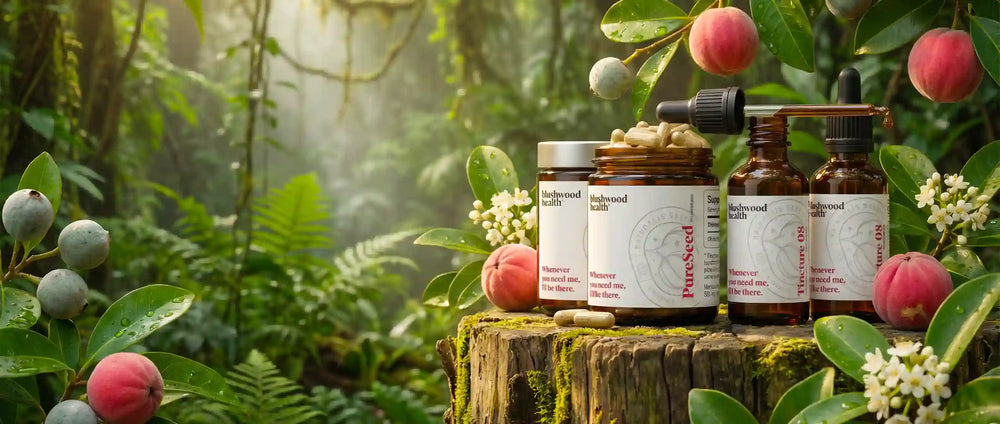
Liquid tinctures taken sublingually bypass much of the gastrointestinal transit that degrades polyphenols before absorption. Sublingual delivery allows bioactive compounds to enter the bloodstream directly through the highly vascular mucosa under the tongue — a route that can meaningfully improve the effective dose reaching target tissues. This is one reason Tincture 08, Blushwood Health's sublingual liquid extract, takes this delivery approach seriously. For those who prefer a capsule format, PureSeed (60-count capsules) provides a carefully standardised seed extract in a convenient oral dose.
Both products are available at blushwood.health. Pairing either supplement with a dietary pattern rich in diverse polyphenols — colourful vegetables, berries, herbs, and legumes — provides the nutritional foundation that supports optimal absorption and synergistic activity.
Supporting Your Body's Inflammation Response: A Practical Framework
The science converges on a consistent message: botanical compounds work best in context. Flavonoid synergy, gut microbiome support, adequate sleep, stress management, and movement all contribute to a resilient, well-regulated inflammatory response. No single supplement operates in isolation any more than a single molecule does inside a cell.
What botanical compounds like those found in Fontainea picrosperma seed extract offer is a complexity that mirrors the complexity of the biology they're intended to support. Multi-target engagement. Complementary mechanisms. A whole-plant matrix shaped by millions of years of evolutionary pressure to do exactly what a modern wellness consumer needs: support the body's own capacity to find and maintain balance.
Frequently Asked Questions
What is flavonoid synergy and why does it matter for inflammation?
Flavonoid synergy refers to the phenomenon where multiple botanical compounds work together to produce effects greater than any single compound could achieve alone. For inflammation specifically, this matters because the inflammatory cascade involves many interconnected pathways — and botanical extracts containing diverse flavonoids can engage multiple nodes simultaneously, supporting a more comprehensive and balanced response than isolated single-molecule supplements.
What makes EBC-46 from Fontainea picrosperma different from regular flavonoids?
EBC-46 (tigilanol tiglate) is a tigliane diterpene ester — structurally distinct from flavonoids — that activates protein kinase C (PKC), a key regulator of cellular signalling, immune activation, and inflammatory response. While flavonoids primarily modulate transcription factors like NF-κB and enzymatic activity, EBC-46 operates through a complementary upstream signalling mechanism, making the full phytochemical profile of Fontainea picrosperma seed extract uniquely multi-target in its activity.
How does sublingual delivery improve botanical compound absorption?
The sublingual mucosa is richly vascularised and allows compounds to pass directly into systemic circulation, bypassing first-pass hepatic metabolism and the degradative environment of the gastrointestinal tract. For polyphenols and diterpene esters — which are often metabolised or structurally altered during digestion — sublingual delivery can meaningfully improve how much active compound actually reaches target tissues.
Can I take Blushwood Berry extract alongside other anti-inflammatory supplements?
Many people include Blushwood Berry extract as part of a broader botanical wellness routine that includes turmeric, omega-3 fatty acids, and other polyphenol-rich supplements. Given the complementary mechanisms involved, synergistic benefits are biologically plausible. As with any supplement regimen, it's always advisable to discuss with a qualified healthcare practitioner, particularly if you are taking pharmaceutical medications or managing a specific health condition.
What is the difference between Tincture 08 and PureSeed from Blushwood Health?
Tincture 08 is a sublingual liquid extract of Blushwood Berry seed designed for direct absorption under the tongue — ideal for those who want rapid onset and maximum bioavailability. PureSeed is a capsule formulation containing standardised Fontainea picrosperma seed extract in a convenient 60-count format, suited to those who prefer a traditional capsule supplement as part of their daily routine. Both products are third-party tested and manufactured to consistent quality standards.
References
- Middleton E Jr, Kandaswami C, Theoharides TC. The effects of plant flavonoids on mammalian cells: implications for inflammation, heart disease, and cancer. Pharmacol Rev. 2000;52(4):673–751. PMID: 11121513
- Nijveldt RJ, van Nood E, van Hoorn DE, Boelens PG, van Norren K, van Leeuwen PA. Flavonoids: a review of probable mechanisms of action and potential applications. Am J Clin Nutr. 2001;74(4):418–425. PMID: 11566649
- Scalbert A, Johnson IT, Saltmarsh M. Polyphenols: antioxidants and beyond. Am J Clin Nutr. 2005;81(1 Suppl):215S–217S. PMID: 15640483
- Boyle GM, D'Andrea RJ, Brown MP, et al. Intratumoural injection of the novel PKC activator EBC-46 rapidly ablates tumours in mouse models. PLoS One. 2014;9(10):e108887. PMID: 25279470
- Scalbert A, Williamson G. Dietary intake and bioavailability of polyphenols. J Nutr. 2000;130(8S Suppl):2073S–2085S. PMID: 10917926
Experience the Difference of Whole-Plant Blushwood Berry Extract
If you're ready to add a botanically complex, multi-target supplement to your wellness routine, Blushwood Health offers two carefully formulated options:
- Tincture 08 — Our sublingual liquid extract, taken directly under the tongue for maximum bioavailability. Each batch is third-party tested and standardised for EBC-46 content from Fontainea picrosperma seed.
- PureSeed Capsules — 60 capsules of standardised Blushwood Berry seed extract. A simple, convenient way to support your body's natural inflammatory balance every day.
These statements have not been evaluated by the Food and Drug Administration. This product is not intended to diagnose, treat, cure, or prevent any disease.